

Escaping hallucinations requires changing the computational class
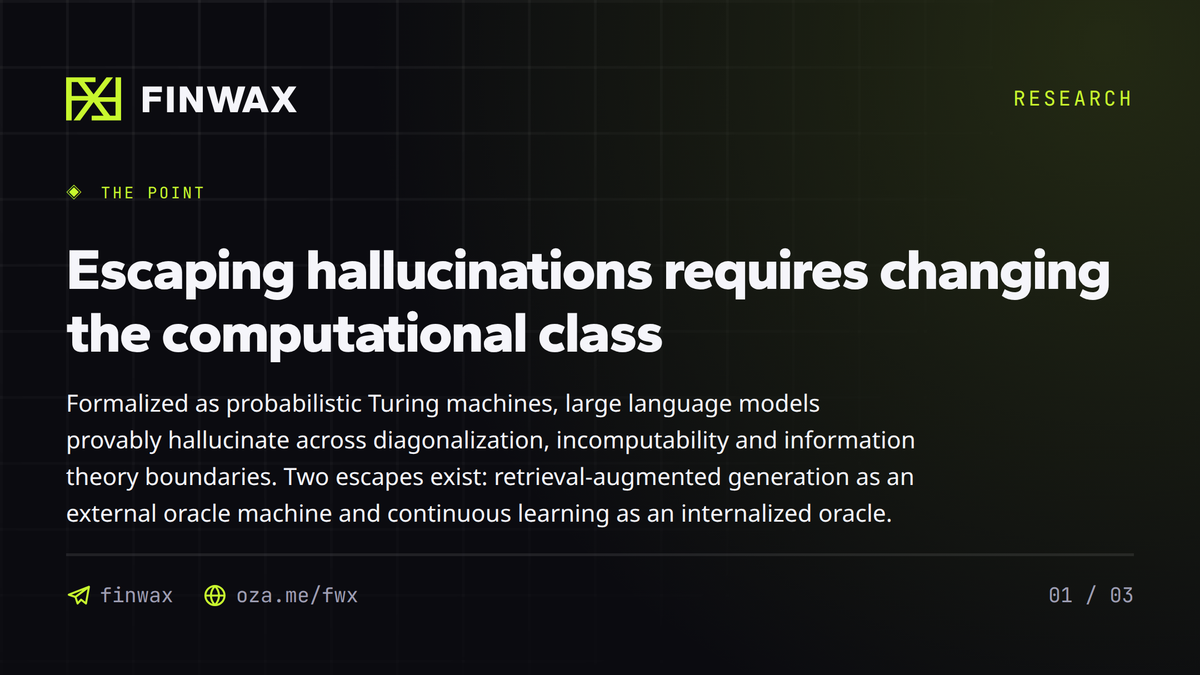
Model hallucinations are not a training defect you can optimize away; they are a formal computational limit of probabilistic Turing machines.
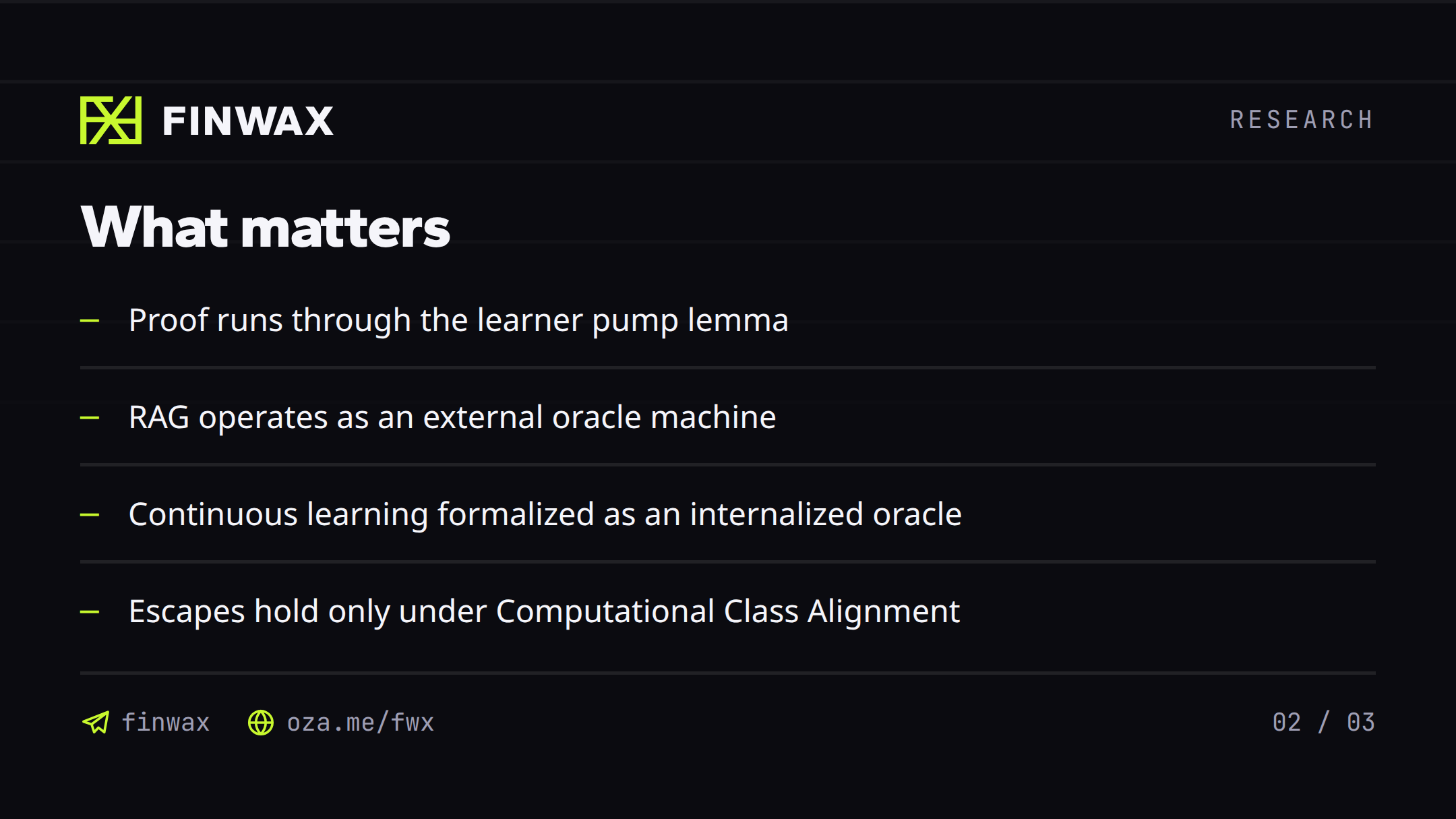
Treating hallucinations as simple alignment or data errors misses the theoretical barrier. When large language models are formalized as probabilistic Turing machines within a computational necessity hierarchy, illusions are proved inevitable across diagonalization, incomputability, and information theory boundaries, established through the learner pump lemma. You cannot train a standalone probabilistic machine out of an incomputability trap.
Escaping this boundary requires altering the system's computational class. The framework demonstrates two formal escape routes:
- RAG as an oracle machine: Retrieval-augmented generation operates as an external oracle. By granting the model computational jumps, an oracle machine provides an absolute escape route from the base limits. This delivers the first formal theoretical proof for why retrieval setups work when pure generation collapses.
- Continuous learning as an internalized oracle: Instead of querying an external store, continuous learning is formalized as an internalized oracle mechanism and executed through a novel neural game theory framework.
Where it breaks is in mismatching the workload to the augmented system. The escape holds only under Computational Class Alignment (CCA), a security principle requiring strict matching between task complexity and the actual computing power of the system. If the complexity of the domain outstrips the computational class of the augmented machine—or if the retrieval mechanism fails to provide genuine computational jumps—the theoretical boundaries reassert themselves and illusions return. Internalizing an oracle via a neural game theory framework likewise fails if the learning dynamic cannot sustain the required computational power.
For builders, the takeaway is structural: stop treating hallucination mitigation as an empirical prompting exercise. When a deployment fails at incomputability or information-theoretic limits, scaling weights will not fix it. You must explicitly upgrade the system's computational class using an oracle machine setup like RAG or an internalized continuous learning framework, ensuring the architecture strictly satisfies Computational Class Alignment against the task.
Comments ()